
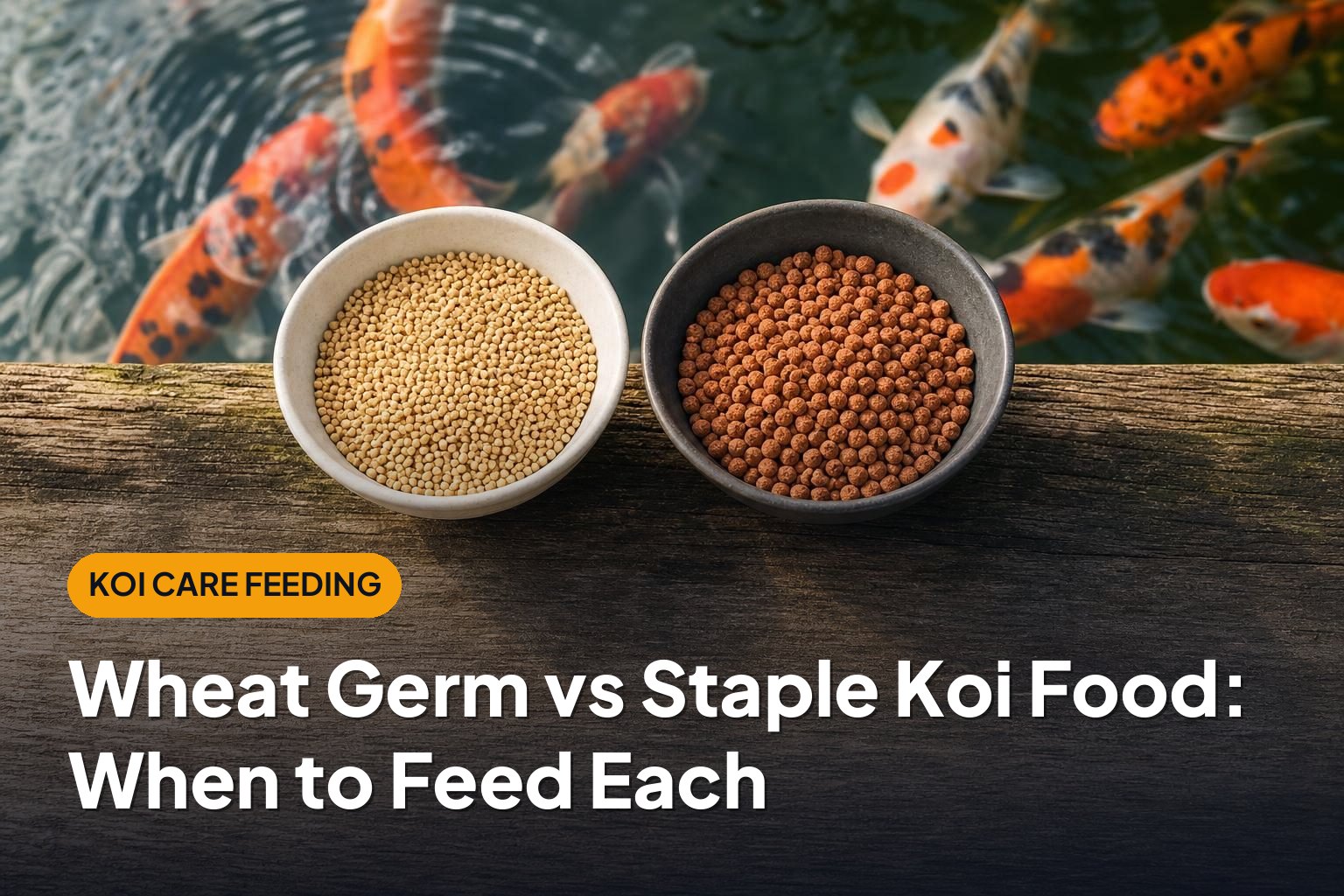
Choosing between wheat germ and staple koi food is mainly about matching the diet to water temperature, your koi’s appetite, and their nutritional needs. Both can have a place in a sensible feeding routine. The key to understanding wheat germ vs staple koi food is that wheat germ formulas are commonly designed for cooler-water feeding, while staple foods usually serve as an everyday maintenance diet during the active season.
Wheat Germ vs Staple Koi Food: Key Differences
The names give you a useful starting point, but they do not tell the whole story. Ingredients, nutrient levels, and recommended feeding temperatures vary between manufacturers. Always compare the actual labels rather than assuming every food in a category performs the same way.
| Feature | Wheat Germ Koi Food | Staple Koi Food |
|---|---|---|
| Main purpose | Often formulated for feeding during cooler conditions and seasonal transitions | Usually formulated for routine maintenance during the active feeding season |
| Typical feeding period | Spring and autumn, where water temperatures remain within the product’s feeding range | Warmer periods when koi are active and feeding consistently |
| Ingredient emphasis | Contains wheat germ as a featured ingredient, alongside other protein and energy sources | Uses a varied ingredient blend to provide everyday nutrition |
| Protein and fat levels | Vary by formula; not automatically low in protein or fat | Vary by formula; often balanced for maintenance rather than maximum growth |
| Main buying advantage | A seasonal option when the manufacturer specifically supports cooler-water use | A practical everyday option for suitable temperatures |
| Main limitation | Does not make feeding safe in water that is too cold for the fish or the product | May not be intended for feeding at lower water temperatures |
| Most important label check | Minimum feeding temperature and whether it is a complete diet | Recommended temperature range, nutritional suitability, and pellet size |
Wheat Germ Koi Food: A Seasonal Feeding Option
What is wheat germ koi food?
Wheat germ is the nutrient-rich embryo of the wheat seed. In koi food, it is combined with other ingredients to make a formulated pellet. It is not the same as feeding plain wheat germ from a grocery store.
Many wheat germ koi foods are marketed for spring and autumn, when pond temperatures are lower and koi are less active than they are in summer. Some are also suitable for broader seasonal use, so the product instructions matter more than the category name alone.
Wheat germ food is not automatically a low-protein food. Nor is it necessarily low in fat. Check the guaranteed analysis and feeding directions to understand what a particular formula is designed to do.
When does wheat germ food make sense?
A wheat germ formula can be useful when koi are interested in eating but conditions are cooler than the recommended range for their usual staple food. This commonly happens as a pond warms in spring or cools in autumn.
- During spring warming: A suitable cooler-water formula may help you restart feeding cautiously once temperatures meet its instructions.
- During autumn cooling: It can provide a seasonal alternative while you gradually reduce feeding.
- In consistently cool ponds: A complete wheat germ diet may be suitable for an extended period if its label supports those conditions.
At around 50–59°F, or 10–15°C, koi often eat less actively than they do in warmer water. That makes measured portions and careful observation especially important. This range is context, not a universal feeding instruction: follow the minimum temperature stated for your chosen food.
What are its limitations?
The biggest mistake is treating wheat germ as permission to keep feeding through any cold spell. Koi are ectothermic, so their metabolism and digestion slow as the water cools. Changing the pellet does not remove that constraint.
Claims that all wheat germ foods are inherently easier to digest also deserve caution. Digestibility depends on the complete formulation, ingredient quality, processing, and water temperature—not simply whether wheat germ appears on the bag.
A seasonal food also cannot compensate for poor water quality. If ammonia or nitrite is detectable, feeding should be reduced or paused as appropriate while the underlying problem is addressed.
Staple Koi Food: The Everyday Maintenance Choice

What is staple koi food?
Staple koi food is generally intended as a regular maintenance diet. A complete staple formula supplies protein, fats, vitamins, and minerals for everyday health, without necessarily emphasizing rapid growth or color enhancement.
However, “staple” is a product description, not a guarantee that every formula has the same nutritional profile. Look for a food identified as complete and suitable for your koi’s size and feeding conditions.
When should you feed staple food?
Staple food is usually the straightforward choice when pond water is consistently within the manufacturer’s recommended range and your koi are feeding normally.
- During the active season: It provides a practical foundation for routine feeding.
- For mixed-size pond collections: An appropriate pellet size, or a combination of sizes, can help different fish feed comfortably.
- For maintenance rather than intensive growth: It suits keepers whose priority is healthy, steady condition rather than pushing size gains.
- In temperature-controlled ponds: It may remain suitable for much of the year if water conditions stay within its intended range.
Warmer water does not automatically mean unlimited food. Feeding must still match fish appetite, stocking level, filtration capacity, and oxygen availability. Very warm conditions can reduce dissolved oxygen and create additional stress.
What are its limitations?
A staple food intended for warmer water may be unsuitable as temperatures fall. Do not assume that simply offering a smaller quantity makes every formula appropriate below its stated feeding range.
Staple diets also differ from specialist growth foods. If you have a specific growth objective, compare complete formulations rather than choosing solely by the word “staple.” For most home ponds, however, sensible portions and good water quality matter more than pursuing an aggressive feeding program.
Which Should You Choose?
For the typical outdoor pond owner: Keep a seasonal pair
Choose staple food for the main active season and a suitable wheat germ formula for cooler transitions. This is a practical approach where pond temperatures change substantially through the seasons.
You do not need large bags of both. Buy quantities you can use while fresh, particularly if the spring or autumn feeding window is short.
For the budget-conscious buyer: Prioritize suitability over variety
Choose one complete food that covers your pond’s normal feeding temperatures, if its label allows it. Two categories are not mandatory for every pond.
If your staple food is not suitable for cooler conditions, either buy an appropriate seasonal food or stop feeding when conditions require it. Using an unsuitable food just to finish the bag is a false economy.
For owners of cool, shaded ponds: Check wheat germ formulas first
Consider a complete wheat germ food with a temperature range that matches your pond. This may be more useful than a warmer-water staple if your koi spend much of the feeding season in cool conditions.
Still compare labels carefully. A wheat germ product with an unsuitable minimum temperature offers no advantage simply because of its name.
For heated-pond owners: A staple diet may be enough
Choose a complete staple food if your water stays consistently within its recommended range. There is no automatic need to switch to wheat germ because the calendar says autumn or winter.
Base changes on measured pond temperature and fish behavior, not the outdoor air temperature alone.
For beginners: Buy a thermometer before extra food varieties
Start with a reliable pond thermometer and one appropriate complete diet. Understanding your pond’s temperature pattern is more valuable than collecting several specialist foods without knowing when to use them.
How to Switch Foods Sensibly
- Check the water temperature. Measure consistently and watch the trend over several days.
- Read both labels. Confirm that the new food is suitable for the conditions and your fish.
- Transition gradually where practical. When both foods are appropriate for the current temperature, mix increasing amounts of the new food over several feeds.
- Keep portions modest. Offer only what the koi actively eat, and remove leftovers promptly.
- Monitor the pond. Watch appetite, behavior, ammonia, and nitrite, especially during spring filter recovery.
If temperatures fall below the old food’s recommended range, do not continue feeding it merely to complete a gradual transition. Temperature suitability takes priority.
Conclusion
The best choice in the wheat germ vs staple koi food comparison depends on your pond, not just the season. Use a suitable staple diet for everyday active-season feeding, and consider wheat germ for cooler periods when its label supports that use. Above all, let water temperature, appetite, and water quality determine when—and how much—you feed.