
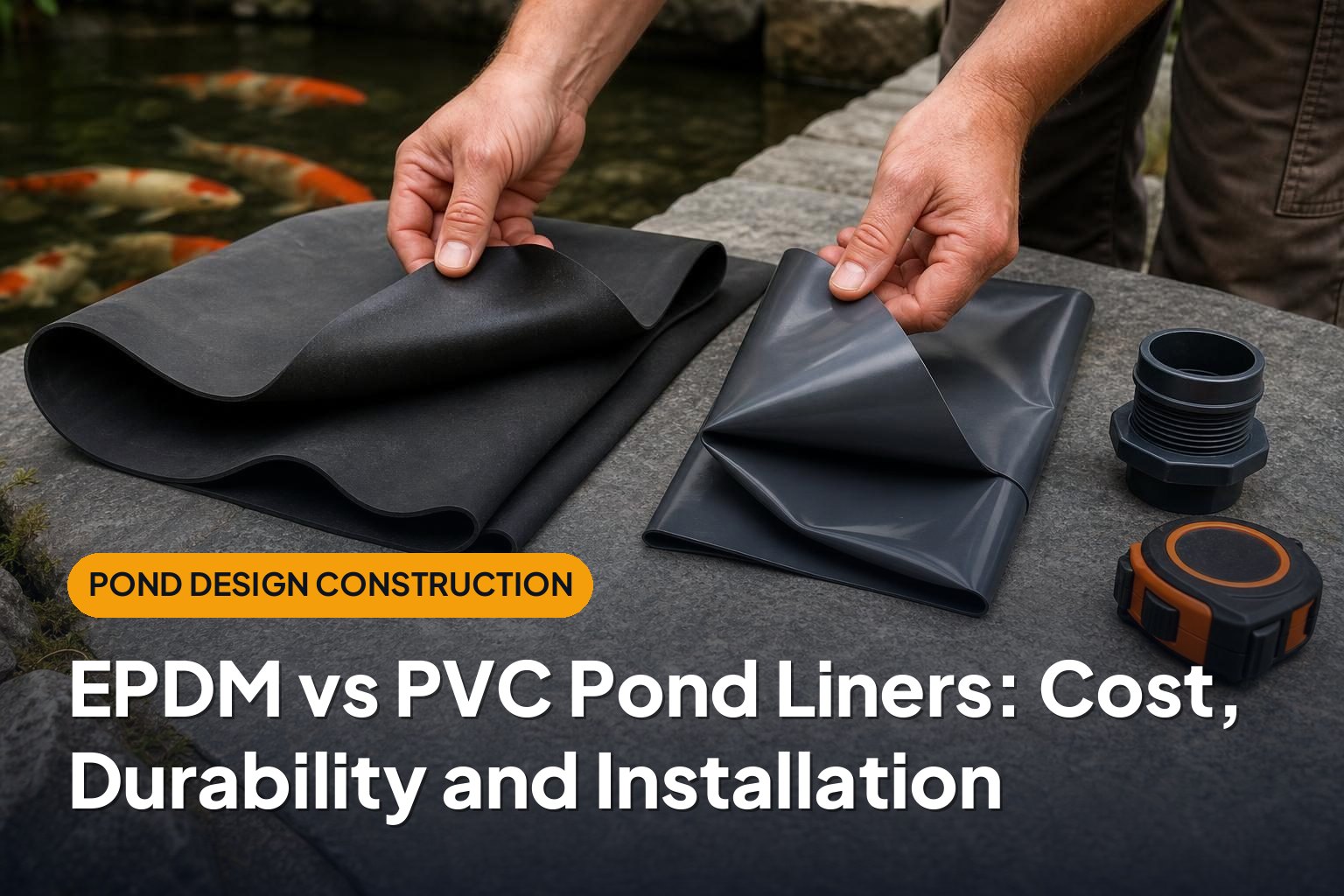
Choosing between EPDM and PVC pond liners affects more than your construction budget. The liner must hold water reliably, fit the pond’s shape, and remain serviceable beneath rocks, pipework, and landscaping. For a koi pond, getting this decision right is especially important because replacing a liner can mean temporarily relocating fish and disturbing the entire pond.
This article is part of our guide: How to Build a Koi Pond: Planning, Sizing and Construction
This EPDM vs PVC pond liner comparison explains the differences in cost, durability, and installation, along with which material makes sense for different pond designs and budgets.
EPDM vs PVC Pond Liner: Key Differences
EPDM is a synthetic rubber, while PVC is a flexible plastic. Both can work in ponds when the specific product is intended for aquatic use, but their flexibility, weather resistance, and handling characteristics differ.
| Factor | EPDM pond liner | PVC pond liner |
|---|---|---|
| Initial cost | Usually costs more than basic PVC | Often the lower-cost option, especially in thinner grades |
| Long-term value | Often attractive for permanent ponds where replacement would be disruptive | Depends heavily on thickness, formulation, protection, and intended service life |
| Flexibility | Very flexible and elastic; conforms well to curves and shelves | Can be flexible, but handling varies with formulation, thickness, and temperature |
| Sunlight exposure | Generally offers strong UV and weather resistance | UV resistance varies; some products require protection from sunlight |
| Cold conditions | Generally remains flexible in cold weather | Some products become noticeably stiffer in low temperatures |
| Handling | Large sheets can be heavy and awkward to position | Thin sheets are often lighter, although thicker or reinforced products vary |
| Seams and repairs | Uses compatible primers, seam tapes, patches, and detailing products | Uses manufacturer-approved bonding or welding methods |
| Typical best fit | Permanent koi ponds and irregular pond shapes | Budget-conscious projects and ponds suited to the selected PVC specification |
EPDM Pond Liners
EPDM stands for ethylene propylene diene monomer. In pond construction, it is valued for its elasticity and resistance to outdoor exposure. A pond-grade EPDM liner is a common choice for a permanent garden or koi pond.
Cost: Higher Up Front, Often Better for Long-Term Projects
EPDM usually costs more than basic PVC when comparing the liner sheets alone. However, the sheet price is only one part of the project cost.
Include protective underlay, delivery, help with positioning, and any manufacturer-approved fittings or seam materials. If a cheaper liner fails beneath finished coping and heavy rockwork, the cost of replacing it can outweigh the initial saving.
Compare complete installations rather than price per unit area alone. A thicker or reinforced PVC liner may also sit in a different price category from thin, entry-level PVC, so not every comparison favors PVC on price.
Durability: Strong Weather Resistance, but Not Puncture-Proof
Quality EPDM is well suited to prolonged outdoor use. Its resistance to sunlight, ozone, and temperature changes is useful around pond edges, where some liner may receive exposure despite careful detailing.
Its elasticity also helps it accommodate small movements in the pond base. That does not make it a substitute for stable construction, compacted ground, or properly supported pond walls.
EPDM can still be punctured by sharp stones, roots, tools, or concentrated loads. Protective underlay is important, and large rocks may need additional cushioning above the liner.
Installation: Forgiving Around Curves, Heavy in Large Sheets
EPDM drapes well into rounded excavations and around shelves. Its flexibility makes it particularly useful for informal pond shapes, although excess material must be arranged into neat folds.
- Use a single sheet where practical to reduce the number of field seams.
- Allow the liner to settle naturally into the excavation rather than pulling it tight.
- Add water gradually while adjusting folds and checking that the liner is supported.
- Use compatible flange fittings and the sealing components specified for them.
- Leave sufficient perimeter allowance before completing the edge.
The main handling drawback is weight. A large folded sheet can require several people to move safely without dragging it across abrasive ground.
Repairs and Limitations
EPDM can often be patched using a compatible repair system. Successful repairs depend on identifying the leak, preparing the surface correctly, and following the product instructions.
Do not assume that roofing rubber is suitable simply because it is also EPDM. Choose a liner specifically documented as suitable for fish ponds; treatments, additives, and product specifications can differ.
PVC Pond Liners

PVC stands for polyvinyl chloride. Flexible PVC liners use additives to produce the required handling characteristics. Their performance varies considerably, so the specification matters more than the material name alone.
Cost: An Accessible Option for Tighter Budgets
Basic PVC pond liner is often cheaper than EPDM. For a modest pond with straightforward access and limited landscaping, that lower initial cost can be worthwhile.
However, avoid treating all PVC liners as equivalent. Thickness, reinforcement, UV stabilization, and manufacturing quality affect both price and suitability. A thin budget sheet is not directly comparable to a heavier-duty lining system.
Check the warranty terms as well as the headline duration. Requirements concerning sunlight exposure, installation, and protective layers can be more useful than a simple warranty-length comparison.
Durability: Product Quality and Protection Matter
A suitable PVC liner can provide reliable service when installed and protected as specified. Its main limitation is that some formulations become less flexible as they age, particularly where heat and sunlight accelerate changes in the material.
Cold weather can also make some PVC products harder to handle. Check the manufacturer’s installation temperature guidance rather than assuming the liner will behave the same in every season.
For a koi pond, confirm that the exact product is suitable for fish and continuous immersion. General-purpose construction sheeting is not an appropriate substitute for pond liner.
Installation: Potentially Easier to Move, but Less Forgiving When Stiff
Thin PVC sheets are often easier to carry and unfold than heavier rubber liners. This can help on smaller DIY projects or sites with restricted access.
However, a stiffer sheet may need more careful folding around tight corners and shelves. Allow it to conform without stretching it across gaps or unsupported corners.
- Install within the temperature range specified by the manufacturer.
- Remove sharp debris and fit a suitable protective underlay.
- Keep exposed edges protected where the product requires UV shielding.
- Use only approved repair, bonding, or welding methods.
- Check compatibility with bottom drains, skimmers, and other penetrations before purchase.
Some PVC liners can be supplied in factory-fabricated shapes or joined using specialist welding methods. These options may suit particular designs, but they are not interchangeable with a simple DIY sheet installation.
Installation Details That Matter With Either Material
Good installation can matter as much as the EPDM vs PVC pond liner choice. Neither material will reliably compensate for sharp rubble, unsupported fittings, or poorly designed edges.
Measure the Finished Pond Profile
Account for the full route down the sides, across the base, and back up, including shelves and sufficient material for anchoring and edging. For irregular ponds, measure several cross-sections and confirm the required sheet size with the supplier.
Plan Penetrations Before Laying the Liner
Bottom drains, returns, and skimmers need compatible mechanical connections and sealing details. Do not rely on an improvised bead of sealant around a pipe pushed through the liner.
Protect the Liner During Construction
Keep tools and sharp offcuts away from the sheet. Support heavy decorative stones properly and use suitable protective layers wherever materials could abrade or puncture the liner.
Fill the pond in stages, checking folds, fittings, and the perimeter as the water rises. Follow the fitting and liner manufacturers’ instructions before trimming excess material or completing permanent edging.
Which Should You Choose?
For a Permanent Koi Pond: Choose Pond-Grade EPDM
EPDM is usually the stronger default recommendation for a permanent koi pond. Its flexibility and weather resistance make it well suited to a long-term installation, especially where replacement would disturb valuable fish, mature landscaping, or substantial stonework.
For a Small Pond on a Tight Budget: Consider PVC
A fish-safe PVC liner can be a sensible choice when keeping initial costs down is a priority. Choose a specification suited to the pond, protect it properly, and avoid selecting solely on the lowest price.
For Curved Ponds and Multiple Shelves: Favor EPDM
EPDM’s elasticity generally makes it easier to work into irregular profiles. Plan folds carefully so they do not create unnecessary pockets for debris.
For a Temporary or Easily Rebuilt Pond: Consider PVC
If the pond is intended to be temporary, or its liner will remain easy to access and replace, PVC’s lower initial cost may offer a practical advantage.
For a Specialist Fabricated Installation: Compare Complete Systems
A reinforced or factory-fabricated PVC system may suit a particular engineered design. In that situation, compare the proposed liner, seams, fittings, installation service, and warranty as one package rather than choosing by material alone.
Conclusion
EPDM usually earns its higher initial cost through flexibility, weather resistance, and suitability for permanent koi ponds. PVC can be a worthwhile budget option when the exact product matches the project. Whichever you choose, prioritize fish-safe materials, protective underlay, compatible fittings, and careful installation over the cheapest sheet price.