
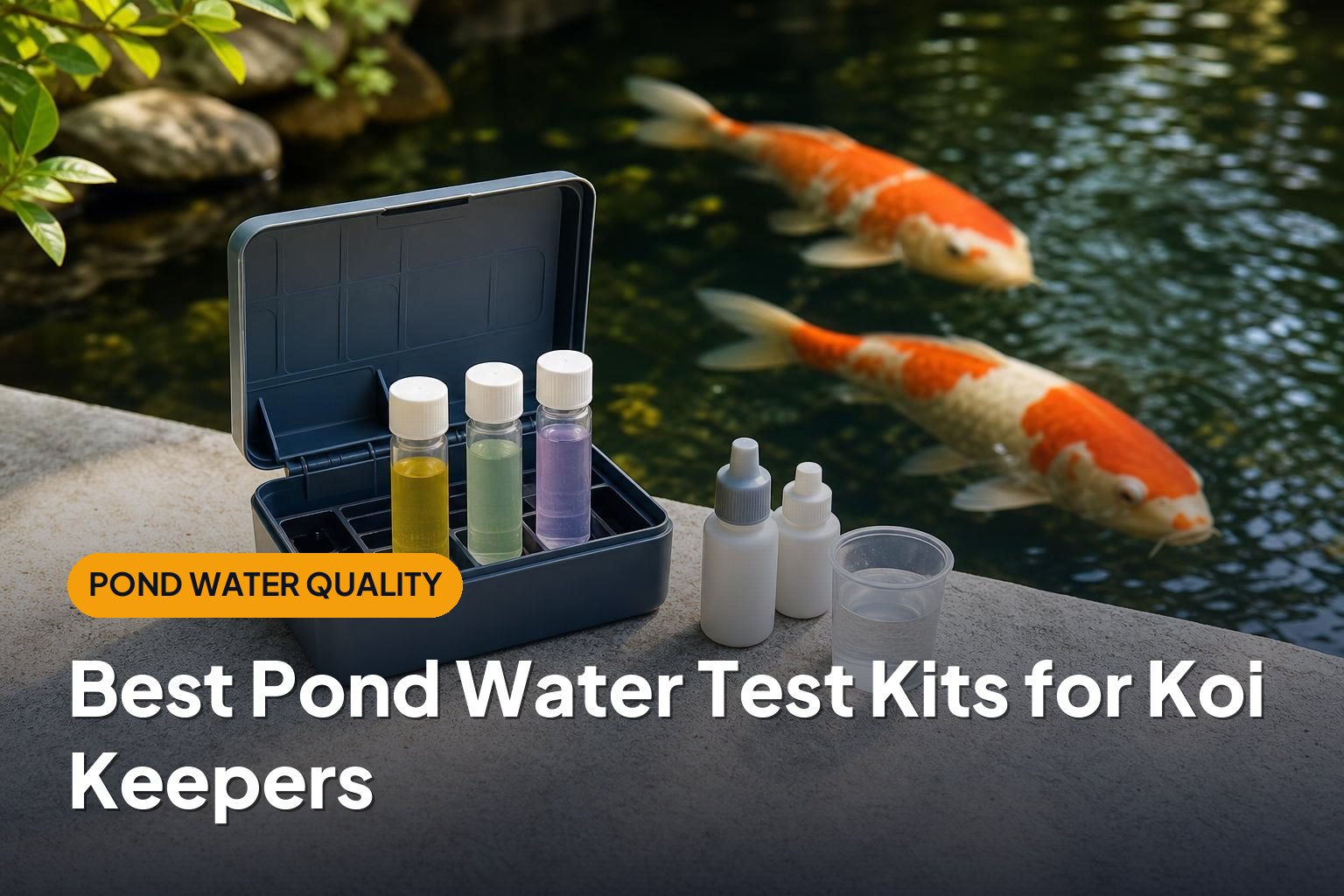
The best pond water test kit for koi is one that helps you catch problems early and that you will use consistently. Start with the quick picks below, then compare what each option measures: some are useful all-rounders, while others need a companion test to cover important gaps.
- Best pond-focused starter kit: API Pond Master Test Kit. A straightforward liquid kit for ammonia, nitrite, pH and phosphate.
- Best general-purpose liquid kit: API Freshwater Master Test Kit. A practical choice when you want ammonia, nitrite and nitrate testing in one box.
- Best broad pond-testing package: NT Labs Pondlab 200. A pond-specific option that includes both waste-related tests and hardness measurements.
- Best for quick routine screening: Tetra Pond Test 6in1. Convenient strips for checking several parameters, but not a substitute for ammonia testing.
- Best specialist addition for alkalinity: Hanna Freshwater Alkalinity Checker. A digital option for koi keepers who want a numerical KH-related reading rather than a visual color match.
1. API Pond Master Test Kit: Best Pond-Focused Starter Kit
The API Pond Master Test Kit is a useful starting point for a new koi keeper. It uses liquid reagents and color charts to measure ammonia, nitrite, pH and phosphate.
Ammonia and nitrite are particularly important because both can harm koi when biological filtration is not keeping up. Testing them is essential during pond startup, after adding fish, and whenever koi behave unusually.
Strengths
- Includes ammonia and nitrite tests, two essentials for monitoring biological filtration.
- Offers a straightforward introduction to liquid water testing.
- Includes phosphate testing, which can help when investigating nutrient inputs and algae growth.
Drawbacks
- Does not include nitrate or carbonate hardness, usually called KH.
- Color matching can be difficult under poor lighting.
- Phosphate results alone will not explain or solve an algae problem.
Best for: Beginners who want a pond-labeled kit and are willing to add a separate KH test. A nitrate test is another useful addition for tracking longer-term nutrient accumulation.
2. API Freshwater Master Test Kit: Best General-Purpose Liquid Kit
Although it is commonly associated with aquariums, the API Freshwater Master Test Kit is suitable for freshwater koi pond samples. It measures ammonia, nitrite, nitrate and pH, with separate standard and high-range pH tests.
That combination makes it a strong everyday choice. Ammonia and nitrite help identify immediate filtration problems, while nitrate provides useful information about nutrient buildup and the effectiveness of your maintenance routine.
Strengths
- Covers the main nitrogen compounds koi keepers routinely monitor.
- Includes two pH ranges, useful when pond water falls outside the standard test’s range.
- Makes a practical core kit when paired with a separate KH test.
Drawbacks
- Does not measure KH, general hardness or chlorine.
- The nitrate test requires careful adherence to the shaking and timing instructions.
- Several individual tests take longer than dipping a multiparameter strip.
Best for: Koi keepers looking for the best pond water test kit to build a routine around. For many ponds, this kit plus a KH drop test is a sensible combination.
3. NT Labs Pondlab 200: Best Broad Pond-Testing Package
NT Labs Pondlab 200 brings together tests for ammonia, nitrite, nitrate, pH, KH and general hardness, or GH. That broader selection helps you assess both biological filtration and the mineral characteristics of your water.
The inclusion of KH is especially useful. Biological filtration consumes alkalinity, and a pond with insufficient buffering can become vulnerable to falling pH. Checking KH helps you spot that vulnerability before relying on a pH reading alone.
Strengths
- Combines the main nitrogen tests with KH and GH.
- Offers broader routine coverage than kits focused only on waste compounds.
- Helps you compare pond water with your source water.
Drawbacks
- A wider test selection means more procedures to learn.
- Liquid testing still depends on correct sample volumes, reagent handling and timing.
- It does not remove the need for a suitable chlorine test when checking replacement water.
Best for: Keepers who want a comprehensive pond-focused starting package without immediately buying separate hardness tests. Check the contents and replacement reagent availability with your supplier before purchasing.
4. Tetra Pond Test 6in1: Best for Quick Routine Screening

Tetra Pond Test 6in1 strips check pH, KH, GH, nitrite, nitrate and chlorine. Their main advantage is convenience: they make it easy to take a quick look at several water parameters.
However, they do not test ammonia. That is a significant limitation for koi ponds, especially during filter startup, after a filtration interruption or when fish appear distressed.
Strengths
- Fast and convenient for routine checks between more detailed testing sessions.
- Includes KH and GH alongside nitrogen-related measurements.
- Requires less preparation than a set of individual liquid tests.
Drawbacks
- Needs a separate ammonia test to cover a major koi health risk.
- Broad color bands can make small changes difficult to distinguish.
- Moisture, storage conditions and incorrect reading times can affect results.
Best for: Busy pond owners who want a quick screening tool alongside liquid tests. Confirm unexpected or borderline readings with an appropriate liquid test rather than making major treatment decisions from a strip alone.
5. Hanna Freshwater Alkalinity Checker: Best Specialist Addition for KH Monitoring
The Hanna Freshwater Alkalinity Checker is a handheld colorimeter that measures alkalinity and displays a numerical result. It is a specialist companion instrument, not a complete pond water test kit.
It is worth considering if visual color matching is frustrating or you want a more consistent way to record alkalinity trends. Choose the freshwater version; marine alkalinity instruments are not interchangeable substitutes.
Strengths
- Provides a digital reading instead of requiring comparison with a printed color chart.
- Useful for keeping an alkalinity log and spotting changes over time.
- Reports results in ppm as calcium carbonate, a standard alkalinity unit.
Drawbacks
- Measures only alkalinity, so you still need ammonia, nitrite, pH and other tests.
- Requires compatible reagents and careful sample preparation.
- Dirty cuvettes, fingerprints, bubbles and procedural errors can affect readings.
Best for: Detail-oriented koi keepers who already own a core test kit. A conventional KH drop test remains a simpler alternative if you do not need a digital display.
Buying Guide: What to Look for in a Pond Water Test Kit
Prioritize the Essential Parameters
For routine koi pond care, build your testing setup around the following measurements:
- Ammonia: Aim for no detectable ammonia. Toxicity depends partly on pH and temperature, so interpret results in context.
- Nitrite: Aim for no detectable nitrite. A rising reading can indicate that biological filtration is struggling.
- pH: Watch for unsuitable readings and significant changes, not just a single number.
- KH: Measures buffering capacity and helps you assess the risk of a pH crash.
- Nitrate: Helps track longer-term nutrient accumulation.
GH can add useful context about your source water. A suitable chlorine test is also valuable when using treated mains water; if your supply contains chloramine, choose a method that measures total chlorine, not only free chlorine.
Choose a Format You Will Use Correctly
Liquid kits offer a useful balance of coverage and readable increments. Strips are convenient for screening, while digital instruments can reduce subjective color matching for specific measurements. None is immune to user error.
Follow the instructions exactly, including shaking requirements and waiting times. Read color charts in good neutral light, and keep test tubes clean.
Check Running Costs and Storage Requirements
Compare replacement reagent availability, expiry dates and the number of tests you are likely to perform. Advertised test totals may combine several different parameters, so they do not necessarily represent that many complete testing sessions.
Store kits as directed, away from excessive heat and sunlight. Keep strips dry and tightly sealed, and replace expired or suspect reagents.
Conclusion
The best pond water test kit covers your pond’s essential risks without making testing a chore. API Freshwater Master paired with a KH test is a practical general-purpose setup, while NT Labs Pondlab 200 offers broader coverage in one package. Use strips for convenience and specialist digital tools where helpful—but always make ammonia, nitrite, pH and KH monitoring a priority.