
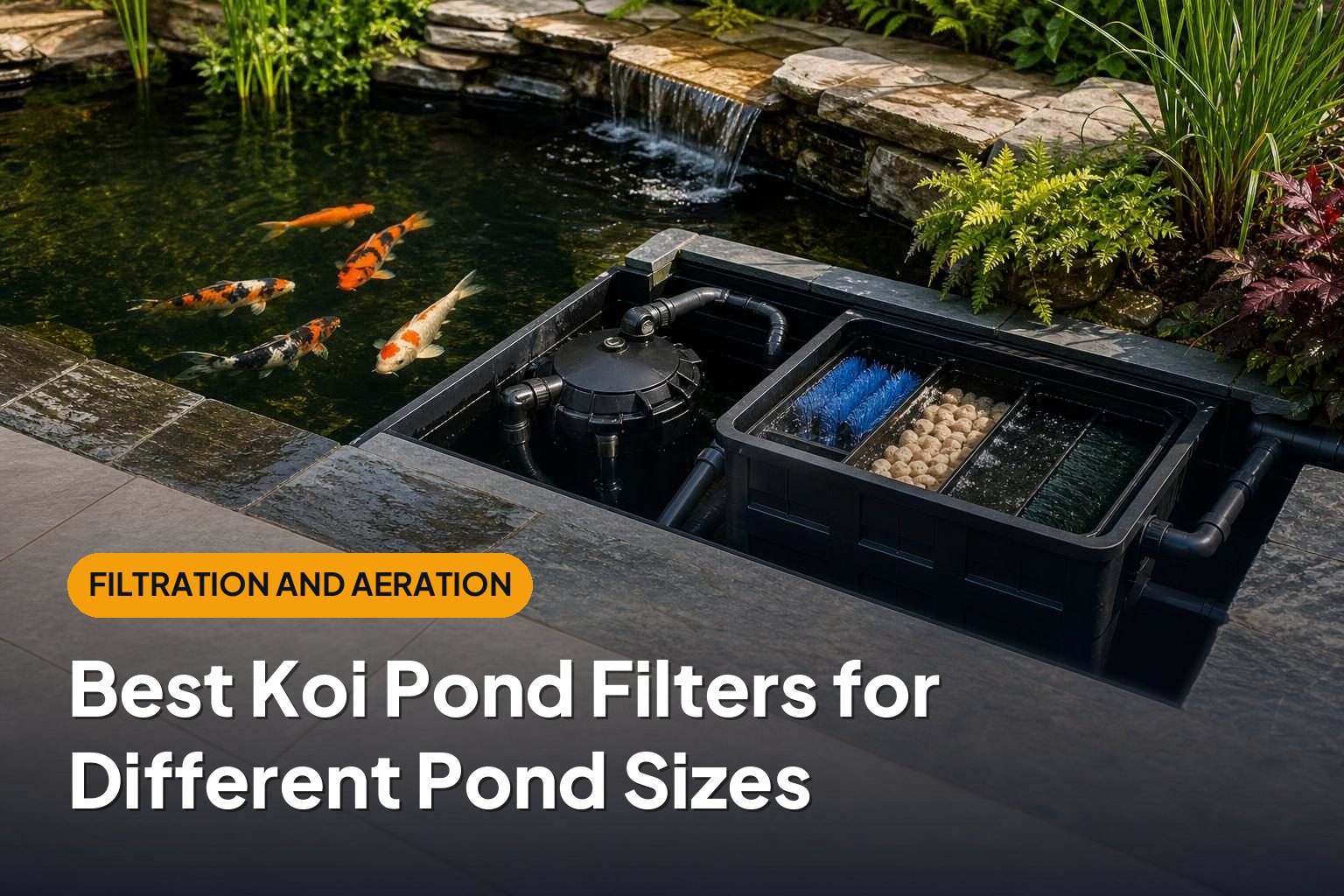
The best koi pond filters match your pond’s volume, fish load, plumbing, and maintenance routine—not just the gallon rating on the box. These quick picks highlight six useful filter types and combinations, from compact systems for smaller ponds to high-capacity setups for large collections. Size ranges are starting points, not guaranteed capacities.
- Best compact option for smaller ponds: Pressurized foam filter with separate biological media.
- Best budget-friendly option for medium ponds: Multi-bay gravity filter.
- Best balanced system for medium to large ponds: Sieve prefilter with a moving-bed biofilter.
- Best enclosed option for larger ponds: Bead filter with effective prefiltration.
- Best low-maintenance option for large, heavily stocked ponds: Rotary drum filter with a moving-bed biofilter.
- Best biological upgrade for high feeding rates: Shower filter with mechanical prefiltration.
1. Pressurized Foam Filter: Best Compact Option for Smaller Koi Ponds
For a smaller, lightly stocked koi pond, a pressurized filter containing foam and biological media can provide a relatively simple filtration setup. Some models include a UV clarifier, which helps control suspended algae that cause green water.
This category is most worth considering for ponds around 500–1,500 US gallons, provided the chosen model is specifically suitable for the actual koi load. At the smaller end, limited swimming space and water stability also deserve careful consideration; filtration alone cannot make an undersized pond suitable for growing koi.
Strengths
- Compact housing can be easier to conceal beside a small pond.
- Pressurized discharge offers flexibility when returning water to a raised outlet, within the unit’s limits.
- Combined mechanical and biological filtration simplifies installation.
Drawbacks
- Foam can clog quickly as koi grow and feeding increases.
- Cleaning mechanisms may not remove all trapped sludge, so periodic opening and thorough cleaning may still be necessary.
- Small integrated biological sections can become the limiting factor.
Buying advice: Look for accessible media, readily available seals and replacement parts, and a clearly stated koi-pond rating. Do not assume a rating for an ornamental pond applies to a heavily stocked koi pond.
2. Multi-Bay Gravity Filter: Best Budget-Friendly Option for Medium Ponds
A multi-bay filter passes water through several chambers, separating solid waste before providing space for biological media. Depending on the design, mechanical stages may use brushes, screens, or matting, followed by aerated biological filtration.
For ponds around 1,000–3,000 US gallons, a generously sized multi-bay system can be a practical choice when space is available and hands-on maintenance is acceptable. Larger versions can serve larger ponds.
Strengths
- Separate chambers make the filtration process easy to understand and inspect.
- Media can often be changed or upgraded as the pond develops.
- Well-designed systems offer substantial biological capacity without complex automation.
Drawbacks
- The footprint can be much larger than that of an enclosed filter.
- Brushes and matting may require messy, frequent cleaning.
- Poorly designed chambers can collect sludge in areas that are difficult to drain.
Buying advice: Prioritize bottom drains on waste-collecting chambers, good access, and a layout that prevents water from bypassing the media. For gravity-fed installations, filter water levels and pipe sizing need careful planning.
3. Sieve Prefilter and Moving-Bed Biofilter: Best Balanced System for Medium to Large Ponds
This combination separates two important jobs. A sieve removes larger solids, while an aerated moving-bed filter houses bacteria that convert ammonia into nitrite and then nitrate.
It is a strong option for ponds around 2,000–6,000 US gallons, although actual capacity depends on the equipment, media quantity, feeding rate, and plumbing.
Strengths
- Removing solids before biological filtration reduces waste accumulation downstream.
- Moving-bed media generally needs little direct cleaning when properly prefiltered and aerated.
- The separate stages allow more flexibility when expanding biological capacity.
Drawbacks
- A sieve will not capture every fine particle, so additional polishing may be desirable.
- The moving bed needs a dependable air supply and correctly sized media-retention screens.
- Some sieve designs require regular screen rinsing and waste removal.
Buying advice: Match the sieve’s operating flow range to the planned system flow. Also check whether it is designed for gravity-fed or pump-fed installation; the two arrangements are not automatically interchangeable.
4. Bead Filter with Prefiltration: Best Enclosed Option for Larger Ponds

A bead filter is a pressurized vessel containing media that captures solids and supports biological activity. It can suit pond owners who want an enclosed system rather than several open filter chambers.
For ponds around 3,000–8,000 US gallons, an appropriately sized bead filter can be useful, especially when paired with a sieve or another effective solids separator. Smaller and larger installations are possible with suitable equipment.
Strengths
- Provides mechanical and biological filtration in an enclosed vessel.
- Can capture fine suspended waste effectively under suitable operating conditions.
- Backwashing avoids routinely lifting out dirty foam or matting.
Drawbacks
- Pressure loss can increase pumping requirements and running costs.
- Backwashing uses pond water and requires a suitable waste outlet.
- Inadequate cleaning can allow solids to accumulate and restrict flow through the media.
Buying advice: Check the required backwash flow, pump requirements, and cleaning procedure before choosing a unit. If the model uses an air blower to agitate the media, include that equipment and its operating needs in your plans.
5. Rotary Drum Filter and Moving Bed: Best Low-Maintenance System for Large Koi Ponds
A rotary drum filter, often called an RDF, captures solids on a fine screen and automatically rinses the screen when cleaning is triggered. A separate moving-bed stage supplies biological filtration, although some units combine both stages in one housing.
This is especially attractive for ponds of 5,000 US gallons and above, or smaller ponds with substantial feeding loads. The main advantage is reduced routine solids-cleaning work, rather than suitability for one particular pond volume.
Strengths
- Automatic cleaning reduces the need to manually rinse mechanical media.
- Frequent waste discharge limits how long captured solids remain in the system.
- Separate biological capacity can be sized around the expected feeding load.
Drawbacks
- Higher initial cost and greater mechanical complexity than simpler filters.
- Motors, sensors, spray nozzles, and controls require inspection and occasional servicing.
- Rinse water, drainage, and fault protection must be planned carefully.
Buying advice: Prioritize service access, replacement-part availability, and a safe response to blocked screens or equipment failure. Automatic cleaning does not eliminate the need to inspect the system.
6. Shower Filter with Mechanical Prefiltration: Best Biological Upgrade for Heavy Feeding
A shower filter distributes water over exposed biological media in stacked trays or a similar housing. The open design encourages gas exchange while providing oxygen-rich conditions for nitrifying bacteria.
It can benefit medium and large ponds, particularly those with high feeding rates. However, a shower is primarily a biological stage: it should not be treated as a complete replacement for mechanical filtration.
Strengths
- Supports biological filtration alongside vigorous gas exchange.
- Can be added to an existing system when more biological capacity is needed.
- Suitable designs offer accessible trays and straightforward visual inspection.
Drawbacks
- Pumping water to the top adds head and can increase energy consumption.
- Splashing, noise, and an elevated installation may not suit every garden.
- Exposed water can lose heat in cold weather, making seasonal protection important.
Buying advice: Choose media intended for shower use and ensure even water distribution. Effective mechanical prefiltration is essential to prevent solids from accumulating in the media.
Buying Guide: How to Choose the Best Koi Pond Filters
Size for Fish and Feeding, Not Gallons Alone
Pond volume is only the starting point. Several large koi receiving substantial food can place more demand on filtration than a larger pond containing a few small fish. Where available, compare the manufacturer’s supported daily feed load as well as its koi-pond volume rating.
Include Both Mechanical and Biological Filtration
Mechanical filtration removes solid waste. Biological filtration processes dissolved nitrogen waste. Most successful koi systems provide dedicated capacity for both, ideally removing solids before they reach the main biological media.
Check Real Flow and Plumbing Compatibility
Use the pump’s expected flow at the actual operating head, not its maximum advertised flow. Account for pipe friction, elevation, UV units, and filter resistance, while staying within each component’s operating limits.
Plan Maintenance, Aeration, and Waste Disposal
A filter that is awkward to clean is harder to keep working well. Check access, cleaning frequency, waste-water routing, and ongoing electricity use. Provide adequate pond aeration as well; an aerated filter does not automatically meet every oxygen need in the pond.
Allow for Maturation and Growth
New biological filters need time to establish. Test ammonia and nitrite during startup and after increases in feeding or stocking. Leave capacity for growing koi rather than choosing equipment that only meets today’s load.
Conclusion
The best koi pond filters make waste removal manageable and provide enough biological capacity for the fish you intend to keep. Compact pressure filters suit some smaller, lightly stocked ponds, while larger systems often benefit from separate mechanical and biological stages. Choose around feeding load, dependable flow, and maintenance you can realistically sustain.